

History
Browse through our extensive collection of teaching materials for the subject History.
Formats
Create interactive content and much more optimized for the subject History.
New worksheets
Recently published worksheets for History.
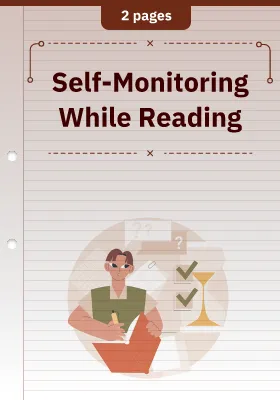
Self-Monitoring While Reading
This worksheet aims to teach students how to actively monitor their own reading comprehension using structured self-check strategies
Content and methods: The worksheet introduces two self-monitoring tools through informational texts about caring for the planet. First, students apply the "Traffic Light Check" by moving a paper clip across colored indicators to rate their paragraph-by-paragraph understanding and identify comprehension breakdowns. Second, they use the "3-2-1 Quick Check" to extract three facts, formulate two open questions, and summarize the central idea in one sentence, followed by a peer discussion and a plenary question round.
Competencies:
Reading comprehension and metacognitive self-monitoring
Information extraction and summarization
Question formulation and inquiry skills
Collaborative peer exchange and communication
Target group: Grade 5 and above
Note: Each student will need a piece of paper and a paper clip to complete the activity. The progress checks should be completed on paper, not digitally.
Subject specific written language - linguistic devices
Learning Objectives
The overarching learning objective is to develop students’ awareness and mastery of the characteristics of academic and subject-specific language, as well as to strengthen their ability to transform language. Students should learn to analyse typical features of academic texts (technical terminology, passive voice, and nominal style) according to defined criteria, reflect on their functional effects in terms of objectivity and how they guide the reader, and purposefully translate dense, nominalised academic language into clear, accessible verbal style using active voice.
Content and Methods
The worksheet introduces the key characteristics of academic non-fiction texts (technical terminology, passive voice, and nominal style) and combines text analysis with practical language exercises. Working with a subject-specific text, students first compile a glossary of technical terms with context-based definitions and distinguish between passive constructions and nominal style using a two-colour highlighting technique.
Building on this, they conduct a functional stylistic analysis to examine the intended effects of linguistic density and the author’s conveyed stance towards the subject matter. The worksheet concludes with an active language transformation task in which students rewrite a highly nominalised example sentence that omits the agent, turning it into dynamic active-voice sentences. This involves breaking down complex verb-noun constructions and explicitly introducing the actors performing the actions.
Competencies
Linguistic and grammatical analysis: Confidently identifying and clarifying technical terminology, as well as recognising syntactic forms of linguistic compression (nominal style and passive constructions).
Functional and stylistic judgement: Reflecting on the rhetorical effects and functions of linguistic distance, objectivity, and impersonal presentation in academic texts.
Language transformation: Purposefully translating complex, agentless nominal constructions into clear, action-oriented active sentences using verbal style.
Lexical comprehension: Deriving the meaning of unfamiliar or highly specialised technical terms from context and formulating concise definitions (glossary work).
Target Group and Level
Upper secondary school (advanced level).
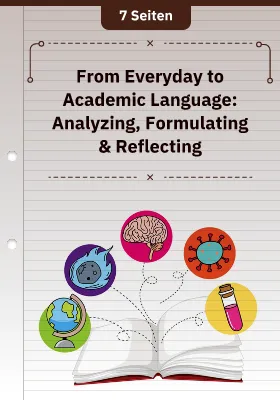
From Everyday to Academic Language: Analyzing, Formulating & Reflecting
This worksheet aims to provide students with a solid understanding of the significance and function of academic language and to help them practice actively using it in subject-specific instruction. Students will recognize that academic language serves as an essential tool for presenting complex topics in an objective, impersonal, and precise manner, and that the ability to switch between everyday language and academic language is a key skill. Through guided practice in translating everyday observations into formal language, they learn to use subject-specific linguistic tools, to put their own thoughts into writing in a structured manner, and to reflectively evaluate their own learning process and linguistic expression.
Content and Methods:
The worksheet combines cognitive awareness, guided writing practice, independent text production, and self-evaluation. After an introductory informational text on the distinction between everyday language and academic language, as well as an introduction to subject-specific language tools (e.g., for cause-and-effect relationships, hypothesis formation, or evaluations), learners gradually translate given everyday statements into logically structured academic language. They then apply this translation technique to their own current course material and reflect on the advantages and challenges of academic language formulation. The module concludes with a structured self-assessment matrix designed to evaluate their own language competencies and identify remaining learning needs.
Competencies:
Learners can...
identify the difference between everyday language and academic language and explain the importance of precise technical language for subject-matter understanding.
identify and purposefully apply specific subject-specific language tools (e.g., phrasing guides for descriptions, justifications, and analyses).
systematically translate colloquial observations into precise, factual, and logically structured sentences using formal language.
structure their own conceptual ideas derived from current classroom activities and independently put them into writing using appropriate technical terms.
critically reflect on their own language translation process and evaluate their individual strengths and areas for development in the use of formal language.
Target Audience and Level:
Grade 8 and above
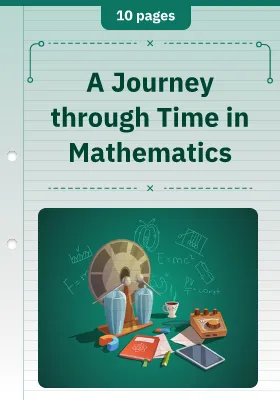
A Journey through Time in Mathematics
The overarching goal of this worksheet is to introduce students to a selected historical numeral system in a hands-on and historically contextualized manner.
Content and Methods:
This worksheet teaches the basics of the numeral system of a selected advanced civilization or historical period through a fictional story told from a child’s perspective. Methodologically, the document combines a true/false comprehension quiz with illustrated arithmetic examples. Students actively apply the principles by solving historical word problems drawn from the child’s everyday life. The worksheet concludes with open-ended reflection and application questions that bridge the gap to the modern mathematical number system and the present day.
Competencies:
Arithmetic Competence
Text and Language Competence: Extracting information from a narrative and describing mathematical phenomena in one’s own words
Cultural and Historical Competence: Reflecting on the evolution of global arithmetic symbols and systems
Target Audience and Level: Grade 5 and above
Note: Due to the background research on ancient forms of calculation, creating this worksheet takes longer.
New content and sources
Published videos and images for History.