to teach logo
Sign up

Exit Ticket: Mindset

TT
by to-teach Team
1 pageGrade 5 and abovenon-subject specific content, Art, Physics, Chemistry, History, Politics, Philosophy, French, Religion
Template

Loading preview…

Your worksheet

Enter the topic of your lesson. The questions will refer to that topic.

Need an idea?

Popular topics from other teachers

How our AI templates work

  • Content gets adapted

    Examples, texts and tasks match your focus.

  • Method & structure stay

    The didactically reviewed structure of the template won't change.

Description

Objective

The primary objective of this "Exit Ticket" is to facilitate student self-reflection on their psychological approach to learning, specifically focusing on the application of a growth mindset within the last lesson's content. It aims to help students identify the difference between productive persistence and self-limiting behaviors when facing academic challenges.

Content and Methods

  • Content: The worksheet centers on real-time reflections regarding the last lesson's topic, including reactions to difficulty and the process of learning new concepts.
  • It addresses key mindset indicators: persistence through struggle, the choice between conceptual understanding and rote memorization, and the perception of mistakes.
  • It explores the social-emotional aspects of learning, such as the willingness to seek help and the ability to process constructive feedback.
  • Methods: The tool is designed as an "Exit Ticket," providing a structured format for formative assessment at the end of a lesson.
  • It utilizes comparative multiple-choice questions to help students categorize their own behaviors as either growth-oriented or fixed.
  • It employs open-ended reflective prompts to encourage students to analyze the impact of their mindset and plan for future improvement.

Competencies

  • Self-Awareness: Developing the ability to recognize one's own emotional and cognitive reactions to frustration and difficulty.
  • Metacognitive Reflection: Thinking about the "how" and "why" of learning, specifically choosing deep understanding over superficial memorization.
  • Resilience and Adaptability: Learning to view errors as data for improvement rather than personal failures.
  • Social Competence: Evaluating how an individual's mindset influences their communication with teachers and peers.

Target Group and Level

Grade 5 and above

Similar worksheets
From Everyday to Academic Language: Analyzing, Formulating & Reflecting

From Everyday to Academic Language: Analyzing, Formulating & Reflecting

This worksheet aims to provide students with a solid understanding of the significance and function of academic language and to help them practice actively using it in subject-specific instruction. Students will recognize that academic language serves as an essential tool for presenting complex topics in an objective, impersonal, and precise manner, and that the ability to switch between everyday language and academic language is a key skill. Through guided practice in translating everyday observations into formal language, they learn to use subject-specific linguistic tools, to put their own thoughts into writing in a structured manner, and to reflectively evaluate their own learning process and linguistic expression.

Content and Methods:

The worksheet combines cognitive awareness, guided writing practice, independent text production, and self-evaluation. After an introductory informational text on the distinction between everyday language and academic language, as well as an introduction to subject-specific language tools (e.g., for cause-and-effect relationships, hypothesis formation, or evaluations), learners gradually translate given everyday statements into logically structured academic language. They then apply this translation technique to their own current course material and reflect on the advantages and challenges of academic language formulation. The module concludes with a structured self-assessment matrix designed to evaluate their own language competencies and identify remaining learning needs.

Competencies:

Learners can...

  • identify the difference between everyday language and academic language and explain the importance of precise technical language for subject-matter understanding.
  • identify and purposefully apply specific subject-specific language tools (e.g., phrasing guides for descriptions, justifications, and analyses).
  • systematically translate colloquial observations into precise, factual, and logically structured sentences using formal language.
  • structure their own conceptual ideas derived from current classroom activities and independently put them into writing using appropriate technical terms.
  • critically reflect on their own language translation process and evaluate their individual strengths and areas for development in the use of formal language.

Target Audience and Level:

Grade 8 and above

non-subject specific contentChemistryBiologyGeographyGerman
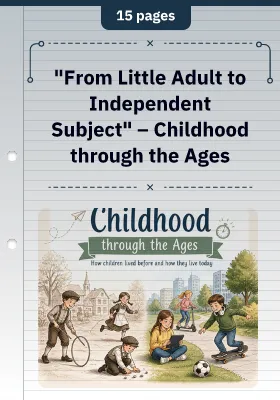
"From Little Adult to Independent Subject" – Childhood through the Ages

"From Little Adult to Independent Subject" – Childhood through the Ages

This worksheet aims to provide trainee teachers with a historically informed and socially critical understanding of the life stage known as ‘childhood’. Learners are to be made aware that childhood is not a rigid, biological state, but is subject to constant social change. They will learn to analyse historical patterns of upbringing and living environments, to contextualise the contemporary view of the child (including the UN Convention on the Rights of the Child), and to draw conclusions for their own professional approach by comparing the past and the present.

Content and methods:

This worksheet combines historical text analysis, the development of empathy, analysis of contemporary issues and research into international law. Following a personal reflection and an analysis of a historical period, the pupils write a fictional diary entry from a child’s perspective and contrast this with the reaction of a child today. They then map out the cornerstones of modern childhood in a practical matrix and compare historical and contemporary living conditions. The activity concludes with research into the UN Convention on the Rights of the Child, including its historical context, and a reflection on their own pedagogical approach.


Competencies:

Learners can...

  • Explain the concept of childhood as a socially shaped and historically changeable construct.
  • Analyse children’s historical living environments in terms of educational objectives, work requirements and legal status, guided by specific criteria.
  • Develop historical empathy through methods of shifting perspectives and reflect on different living conditions from multiple perspectives.
  • Identify the dimensions of modern childhood (including subject status, institutionalisation and mediatisation) and illustrate them using concrete examples from practice.
  • Independently research articles of the UN Convention on the Rights of the Child, place them in their historical context and relate them to today’s image of the child.
  • Use historical insights to critically examine current patterns of upbringing and apply them to one’s own professional approach.


Target group and level:

Adult students or trainees in the field of social pedagogy, particularly aspiring educators.


Note: Internet access is required for the research task

PedagogySocial PedagogyHistoryHealth and Social Care
Theories - Applying and Exploring Them in Depth

Theories - Applying and Exploring Them in Depth

The worksheet aims to provide students with a deep understanding of a pedagogical theory. Students apply central technical terms, transfer theoretical concepts to pedagogical scenarios, and reflect on the relevance of the theory for practical application.

Content and methods:

The focus is on the application, in-depth exploration, and critical reflection of an educational theory. Methodologically, the worksheet combines the translation of technical terms into everyday language, cooperative group work via an expert group method, the elaboration and presentation of subject-specific content, the development of practical case studies, the analysis of different positions and arguments, as well as a concluding reflection and self-assessment.

Competencies:

  • Apply and explain central terms and concepts of a theory
  • Comprehend, structure, and summarize specialized texts
  • Transfer theoretical content to pedagogical situations and case examples
  • Analyze and evaluate professional positions and arguments
  • Formulate and justify personal judgments
  • Reflect on and assess one's own learning progress

Target group and level:

Adult students or trainees in the field of social pedagogy, particularly aspiring educators.

Note on further work: The worksheet serves to deepen and apply a pedagogical theory. It can build upon an introductory worksheet and forms the foundation for further tasks in which theoretical concepts are applied to more complex practical examples and critically reflected upon. Introductory worksheet on the topic: Theories – Fundamentals


Note: Internet access is required for the group research phase.
PedagogyPhilosophyEthicsSocial PedagogyHealth and Social Care
Group Puzzle for Chemistry Class

Group Puzzle for Chemistry Class

Objective: This worksheet uses the cooperative learning method known as the “group puzzle” to teach complex concepts in chemistry and atomic physics. The goal is for students to gain a deep understanding of the selected topic through self-directed learning and peer teaching.


Content and Methods: The content is taught using a structured five-phase model that combines cooperative and independent learning: In home groups, each member takes on a specific subtopic, which is then explored in a subsequent “expert phase” in groups of students with the same subtopic, using informational texts and in-depth tasks. Afterward, the students return to their core groups, share their knowledge with one another, and consolidate their findings together before moving on to a cooperative work phase in which they solve complex tasks that can only be mastered by combining all the individual aspects. The process concludes with a joint evaluation in a plenary session and a reflection on the learning process.


Competencies:

  • Subject-Specific Competence: Acquiring in-depth knowledge of a topic in chemistry
  • Social Competence: Fostering teamwork and communication skills through the “expert” model
  • Methodological Competence: Applying cooperative learning methods to independently process information and convey knowledge
  • Transferability: Applying expert knowledge to hypothetical scenarios, such as the discovery of new elements


Target Audience and Level: High School


Chemistry
Understanding Influencer Marketing

Understanding Influencer Marketing

This worksheet aims to raise students’ awareness of the mechanisms, economic dimensions, and psychological strategies of modern digital marketing in everyday life.

Content and Methods: The material focuses on the economic significance of social media marketing based on statistical data, as well as the analysis of specific digital posts. Methodologically, the worksheet relies on a combination of practical case studies—in which an exemplary social media post is deconstructed both textually and statistically—and theoretical insights into behavioral economic effects. In addition, the material encourages multi-perspective discussion through reflective writing assignments and the comparison of contrasting stakeholder perspectives. Finally, the discussion of complex issues is used to synthesize what has been learned into the formation of independent judgments.

Competencies:

Analytical and Deconstructive Competence: The ability to systematically examine media content and linguistic and statistical devices for their manipulative or promotional effects

Reflective and Critical Thinking Competence: The ability to critically examine one’s own consumer behavior and evaluate economic phenomena from different perspectives

Media and Economic Competence: Understanding of digital market mechanisms, psychological influence strategies such as the authority bias or the bandwagon effect, and their impact on the economy

Target Audience and Level: 9th/10th grade

EconomicsPolitics
The Secrets of Milk

The Secrets of Milk

Objective: This workbook explores a historical and materials-science phenomenon: the production of casein, an early milk-based bioplastic. Students work as a team of researchers to investigate how the organic components of liquid cow’s milk can be transformed into a solid plastic through the action of acid.


Content and Methods: The content is conveyed through a combination of historical contextualization, experimental laboratory work, and material analysis: Starting with the question of how a solid material can be produced from milk, students explore the composition of milk and the effect of acids on proteins. They then experimentally extract casein, document the course of the reaction, and examine the properties of the resulting bioplastic. Finally, the results are used in a scientific application to evaluate the historical significance and material properties of casein as an alternative to plastic.


Competencies:

  • Technical expertise: Understanding of protein denaturation (acid precipitation of milk protein/casein) and the classification of galalith as a historical bioplastic
  • Knowledge acquisition: Planning, conducting, and systematically documenting a preparative organic chemistry experiment (filtration, solid isolation)
  • Materials and testing skills: Criteria-based analysis of the physical properties of a self-produced solid
  • Argumentation and language skills: Writing a technically sound report using precise scientific explanations


Target audience and level: Middle school

BiologyChemistry